Download Algorithms By Richard Johnsonbaugh, Marcus Schaefer
When having concepts to be a lot more successful as well as better individual, one to always be reminded is about how the process you will certainly gain. Checking out publication is actually one procedure that will certainly support you obtaining the ideas from lots of sources. Also it features every little thing straightforward to complicated; book will certainly accompany you to always include lesson and experience. Algorithms By Richard Johnsonbaugh, Marcus Schaefer as one to refer is additionally one of guides that has terrific breakthroughs. Yeah, every book constantly has very own developments.
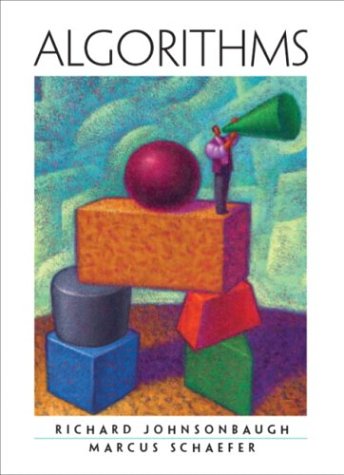
Algorithms By Richard Johnsonbaugh, Marcus Schaefer

Download Algorithms By Richard Johnsonbaugh, Marcus Schaefer
After often times, book becomes one of the manners that will urge the system of life run much better. It includes not just the thoughts, ideas, point of view, however also the truths. Several facts have been exposed from guides. Numerous literature jobs are likewise served. When you have more time to read, please read this Algorithms By Richard Johnsonbaugh, Marcus Schaefer as one of the analysis products!
Obviously, from youth to permanently, we are constantly believed to like analysis. It is not only checking out the lesson book however likewise checking out every little thing good is the selection of getting brand-new ideas. Religion, scientific researches, politics, social, literary works, and fictions will enrich you for not only one aspect. Having even more aspects to know and recognize will certainly lead you end up being someone more valuable. Yea, ending up being precious can be located with the presentation of how your expertise a lot.
This publication will show you the current book that can be gained in some places. However, the motivating book will be a lot more established. Yet this Algorithms By Richard Johnsonbaugh, Marcus Schaefer, it will certainly show you current point that you wish to know. Reading publication as one of the activities in your holidays is very clever. Not everybody will certainly have happy to do it. So, when you are person who enjoy this publication to review, you should delight in the time reading and completing this publication.
Getting this book in this website may not lead you to stroll and most likely to publication shop. Looking for rack by rack will actually spend your time mostly. Yet, it well not guarantees you to be successful finding Algorithms By Richard Johnsonbaugh, Marcus Schaefer Thus, you can find it in the soft data of this book. It will give you the fantastic system of guide suggestion. You can see the link and most likely to the page to earn handle. And currently, your book filter file of this can be your picked book as well as area to read this intriguing publication.
- Amazon Sales Rank: #428126 in Books
- Published on: 2003-08-10
- Ingredients: Example Ingredients
- Original language: English
- Number of items: 1
- Dimensions: 10.10" h x 1.80" w x 8.20" l, 3.30 pounds
- Binding: Hardcover
- 768 pages
From the Back Cover
Algorithms is written for an introductory upper-level undergraduate or graduate course in algorithms. With/their many years of experience in teaching algorithms courses, Richard Johnsonbaugh and Marcus Schaefer include applications of algorithms, examples, end-of-section exercises, end-of-chapter exercises, solutions to selected exercises, and notes to help the reader understand and master algorithms.
Key Features- Links theory to real-world applications such as data compression, region-finding in digital pictures, cellular phone networks, and the implementation of agrep.
- Includes five chapters that emphasize design techniques: searching (including backtracking), divide and conquer, sorting, selection, the greedy method, and dynamic programming.
- Covers distributed algorithms—a topic recommended by the ACM (2001 report) for an undergraduate curriculum.
- Features a collection of techniques, including approximation, parameterization (a recent area of research), and use of heuristics, to deal with NP-complete problems.
- Contains more than 1450 carefully developed and classroom-tested exercises, from routine to challenging. About one-third of the end-of-section exercises include solutions.
- Provides a robust Companion Website that supplements the text by providing algorithm simulation software, PowerPoint® slides, late breaking news about algorithms, references about the book's topics, computer programs, and more.
- Includes more than 300 worked examples, which provide motivation, clarify concepts, and show how to develop algorithms, demonstrate applications of the theory, and elucidate proofs.
About the Author
Richard Johnsonbaugh is Professor Emeritus of Computer Science at DePaul University. He has degrees in computer science and mathematics from the University of Oregon, Yale University, and the University of Illinois at Chicago. He is the author of numerous articles and books, including Discrete Mathematics, Fifth Edition, and, with co-author Martin Kalin, Object-Oriented Programming in C++, Second Edition, Applications Programming in C++, and Applications Programming in ANSI C, Third Edition.
Marcus Schaefer is Assistant Professor of Computer Science at DePaul University. He holds degrees in computer science and mathematics from the University of Chicago and the Universitat Karlsruhe. He has authored and co-authored several articles on complexity theory, computability, and graph theory.
Excerpt. © Reprinted by permission. All rights reserved. Why We Wrote This Book
Intended for an upper-level undergraduate or graduate course in algorithms, this book is based on our combined 25 years of experience in teaching this course. Our major goals in writing this book were to
- Emphasize design techniques.
- Show that algorithms are fun and exciting.
- Include real-world applications.
- Provide numerous worked examples and exercises.
Faced with a new computational problem, a designer will often be able to solve it by using one of the algorithms in this book, perhaps after modifying or adapting it slightly. However, some problems cannot be solved by any of the algorithms in this book. For this reason, we present a repertoire of design techniques that can be used to solve the problem and help the reader to develop intuition about which techniques are likely to succeed. The chapters on NP-completeness and how to deal with it also tell how to recognize problems that are hard to solve and which techniques are available in that case.
Working with algorithms should be fun and exciting. The design of algorithms is a creative task requiring the solution of new problems and old problems in disguise. To be successful, we believe that it is important to enjoy the challenge that a new problem poses. To this end, we have included more examples and exercises of a combinatorial and recreational nature than is typical for a book of this type. All too often the challenge of an unsolved problem is experienced as a threat rather than as an opportunity, and we hope that these examples and exercises help to remove the threat.
Examples of real-word applications of algorithms in this book include data compression in Section 7.5, and the Boyer-Moore-Horspool algorithm in Section 9.4, which is used as part of the implementation of agrep. Most sections of the book introduce a motivating example in the first paragraph. The closest-pair problem (Section 5.3) begins with a pattern recognition example, and Section 8.4, which is concerned with the longest-common-subsequence problem, begins with a discussion of the analysis of proteins.
Algorithm design and analysis are best learned by experience. For this reason, we provide large numbers of worked examples and exercises. Worked examples show how to deal with algorithms, and exercises let the reader practice the techniques. There are over 300 worked examples throughout the book. These examples clarify and show how to develop algorithms, demonstrate applications of the theory, elucidate proofs, and help to motivate the material. The book contains over 1450 exercises, from routine to challenging, which were carefully developed through classroom testing. Close attention was paid to clarity and precision. Because some instant feedback is essential for students, we provide answers to about one-third of the end-of-section exercises (marked with "S" in the exercises) in the back of the book. Solutions to the remaining end-of-section exercises are reserved for instructors (see the Instructor Supplement section that follows).
PrerequisitesThe principal computer science prerequisite is a data structures course that covers stacks, queues, linked lists, trees, and graphs. A course in discrete mathematics that covers logic, asymptotic notation (e.g., "big oh" notation), and recurrence relations and their solution by iteration is the main mathematics prerequisite. We do not use advanced methods such as generating functions. In one or two places, we use some basic concepts from calculus. The mathematics topics and data structures used in this book are summarized in Chapters 2 and 3. Some or all of these chapters can be used for reference or review or incorporated into an algorithms course as needed.
ContentFollowing the first three chapters (containing an introduction, mathematics topics, and data structures), the book presents five chapters that emphasize design techniques.
Chapter 4 features searching techniques, including novel applications such as region-finding in digital pictures.
The divide-and-conquer technique is introduced in Chapter 5. Among the problems considered are a tiling problem, finding the closest pair of points in the plane, and Strassen's matrix-product algorithm. Chapter 6 deals with sorting and selection. Divide-and-conquer is used to develop many of the algorithms in this chapter.
Chapter 7 shows how to use the greedy method to develop algorithms. After showing how to use the greedy method in a simple setting (coin changing), we present Kruskal's algorithm, Prim's algorithm, Dijkstra's algorithm, Huffman's algorithm, and a solution of the continuous-knapsack problem.
Chapter 8 covers the technique of dynamic programming. As in Chapter 7, we first show how dynamic programming operates in a simple setting (computing Fibonacci numbers). We next revisit the coin-changing problem (from Chapter 7 on the greedy method) and contrast dynamic programming with the greedy method. We then discuss optimal grouping of matrices, the longest-common-subsequence problem, and the algorithms of Floyd and Warshall.
Chapter 9 discusses text-searching techniques, including the Knuth-Morris-Pratt and Boyer-Moore-Horspool algorithms, and algorithms for non-exact searching.
In Chapter 10, we investigate NP-completeness—a theoretical approach to recognizing and understanding the limitations of algorithms. We include many examples from different areas such as cellular phone networks, games, and biological computing to illustrate the ubiquity and universality of NPcompleteness.
It is widely believed that NP-complete problems cannot be solved efficiently by algorithms. Nevertheless, these problems arise in applications and have to be solved in practice. Chapter 11, Coping with NP-Completeness, presents a collection of techniques originating in practice and theory to deal with NP-complete problems. Among the approaches discussed are approximation, parameterization, and use of heuristics.
Chapter 12 presents fundamental algorithms for parallel architectures, including algorithms for the PRAM and sorting networks, and offers an introduction to computation in distributed environments.
PedagogyEach section (except Section 12.1, which is an introductory section) concludes with Section Exercises. The book contains over 1100 Section Exercises. Some of these exercises check for basic understanding of the material (e.g., some ask for a trace of an algorithm), while others check for a deeper understanding of the material (e.g., some investigate alternative algorithms). Exercises that are more challenging than average are indicated with a star, *.
Each chapter ends with a Notes section, which is followed by Chapter Exercises. Notes sections contain suggestions for further reading and pointers to references. Chapter Exercises, some of which have hints, integrate the material of the chapter. The book contains over 350 Chapter Exercises. They are, on the whole, more challenging than the Section Exercises. We have included some very challenging Chapter Exercises marked with two stars. These will probably require instructor guidance, and some are appropriate for a small project.
Lower bounds for problems are integrated into the chapters that discuss those problems rather than being segregated into separate chapters. For example, after presenting several sorting algorithms, we discuss a lower bound for comparison-based sorting (Section 6.3).
We present and discuss many recent results, for example, parameterized complexity (Section 11.4), a recent area of research.
Algorithms are written in pseudocode that is close to the syntax of the familiar C, C++, and Java family of languages. Data types, semicolons, obscure features of the languages, and so on, are not used because we have found that specifying algorithms by writing actual code obscures the algorithm description and makes it difficult for someone not familiar with the language to understand the algorithm. The pseudocode used is completely described
Figures illustrate concepts, show how algorithms work, elucidate proofs, and motivate the material. Several figures illustrate proofs of theorems. The captions of these figures provide additional explanation and insight into the proofs.
Attention has been given to finding the most direct and comprehensible proofs of correctness as examples, see Theorem 7.2.5 from which the correctness of both Kruskal's and Prim's algorithms are derived and the proof of the correctness of Dijkstra's algorithm (Theorem 7.4.5).
We present several examples and arguments to show that our time bounds for algorithms are sharp. See, for example, the subsection in Section 7.3, Lower Bound Time Estimate, which shows that the upper bound for the worst-case time of Prim's algorithm using a binary heap is sharp, and the discussion just before Theorem 7.5.4, which shows that the upper bound for the worst-case time of Huffman's algorithm is sharp.,
Algorithms
By Richard Johnsonbaugh, Marcus Schaefer PDF
Algorithms
By Richard Johnsonbaugh, Marcus Schaefer EPub
Algorithms
By Richard Johnsonbaugh, Marcus Schaefer Doc
Algorithms
By Richard Johnsonbaugh, Marcus Schaefer iBooks
Algorithms
By Richard Johnsonbaugh, Marcus Schaefer rtf
Algorithms
By Richard Johnsonbaugh, Marcus Schaefer Mobipocket
Algorithms
By Richard Johnsonbaugh, Marcus Schaefer Kindle